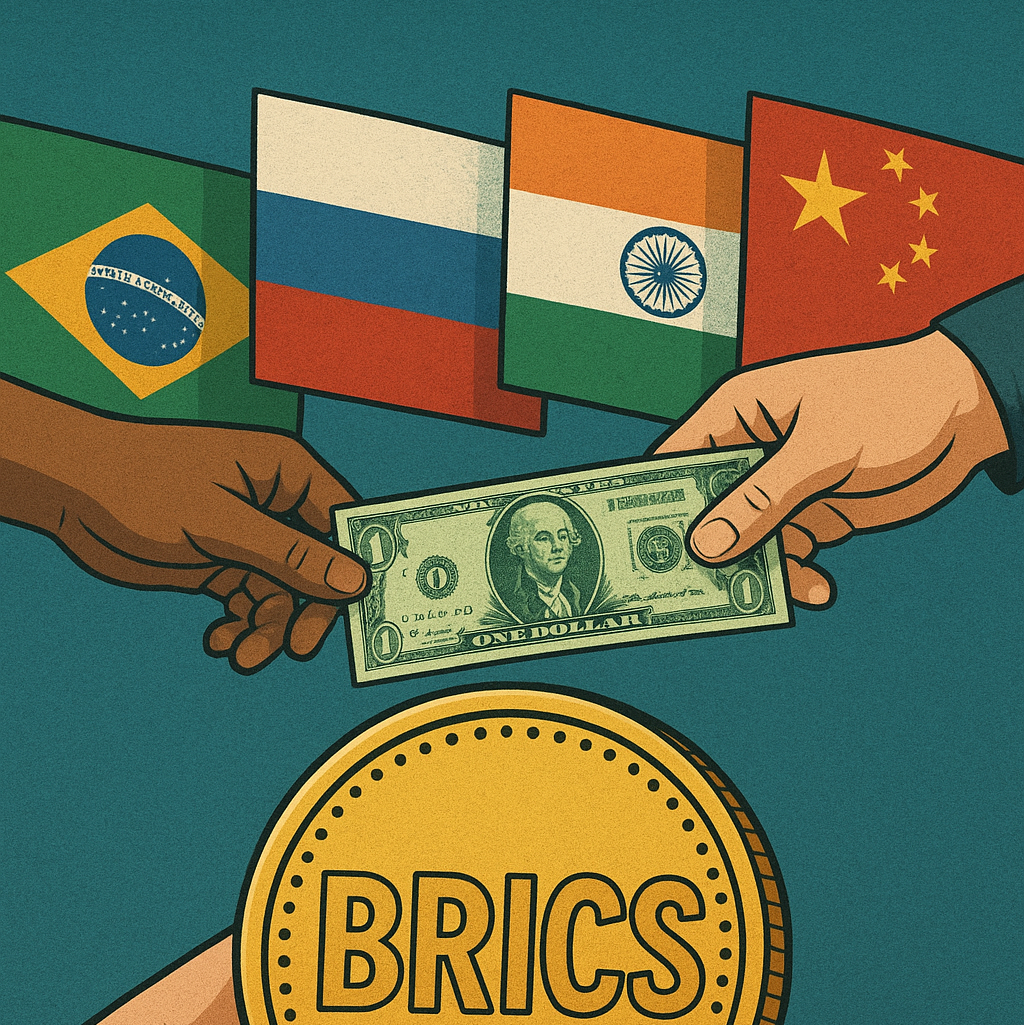
Introduction: The Birth of a New Economic Order
For decades, the world economy has revolved around the US dollar, which serves as the primary global reserve currency. International trade, oil transactions, and even debt settlements are mostly denominated in dollars, granting the United States unparalleled financial influence. However, the rise of the BRICS bloc (Brazil, Russia, India, China, South Africa, and now expanding to include nations like Saudi Arabia, Iran, Egypt, and the UAE) has sparked discussions about creating an independent BRICS currency to rival the dollar-dominated system. If such a currency were to emerge, the ripple effects would be felt across international trade, geopolitics, global finance, and domestic economies worldwide.
The Rationale Behind a BRICS Currency
Challenging Dollar Hegemony
The dominance of the US dollar allows Washington to impose sanctions, control financial flows, and maintain leverage over developing nations. A BRICS currency would directly challenge this dominance, offering member countries independence from the Western-controlled SWIFT system and reducing exposure to dollar fluctuations.
Strengthening South-South Cooperation
By trading in their own currency, BRICS nations could enhance intra-bloc trade, reducing reliance on Western markets. This would also give developing nations in Asia, Africa, and South America an alternative system to participate in global commerce without depending on dollar liquidity.
A Hedge Against Geopolitical Risks
Russia’s exclusion from Western financial systems after the Ukraine conflict highlighted the vulnerability of relying on dollar-based mechanisms. A BRICS currency could act as a shield against sanctions and provide strategic autonomy to its members.
Structural Design of the BRICS Currency
Possible Formats
- Commodity-Backed Currency – Pegged to gold, oil, or rare earth metals, ensuring tangible value.
- Digital Currency (CBDC) – A blockchain-based currency issued by BRICS central banks to facilitate secure and fast transactions.
- Basket Currency – Similar to the IMF’s SDR, composed of the currencies of all member states to maintain balance and stability.
Governance Mechanisms
To avoid dominance by China, the BRICS alliance may adopt a shared governance model, where decision-making power is equally distributed. A supranational BRICS Bank or Monetary Authority could oversee issuance, circulation, and exchange policies.
Impact on Global Trade
Redefining Oil and Commodity Markets
If major oil exporters like Saudi Arabia, Iran, and Russia begin accepting BRICS currency for petroleum sales, the “petrodollar” system could be weakened. This would drastically reduce global dollar demand and increase BRICS currency circulation.
Diversification of Global Reserves
Central banks worldwide might start holding BRICS currency alongside dollars, euros, and yen. Over time, this diversification could undermine the dollar’s monopoly as a reserve asset.
Boosting Intra-BRICS Trade
Currently, trade among BRICS nations often involves converting into dollars before settlement, increasing transaction costs. A shared currency would eliminate conversion inefficiencies, encouraging more direct trade within the bloc.
Geopolitical Implications
Decline of Western Financial Influence
The US and EU’s ability to impose sanctions or control global payment systems would weaken. Countries under sanctions, like Iran or Russia, would gain financial breathing space.
Strengthening Multipolarity
The emergence of a BRICS currency would accelerate the shift from a unipolar (US-led) to a multipolar world order, where different economic blocs balance each other’s influence.
Possible Western Pushback
NATO, G7, and Western-aligned institutions might resist the rise of a BRICS currency by enforcing stricter trade restrictions, political pressure, or incentives for allies to stay within the dollar system.
Benefits for BRICS Nations
Economic Independence
Member states would reduce reliance on the dollar, shielding themselves from external shocks such as US interest rate hikes, which currently impact developing economies significantly.
Financial Stability
A shared currency could help stabilize exchange rates within the bloc, facilitating long-term investments and infrastructure projects under BRICS Bank initiatives.
Global Bargaining Power
A successful currency would enhance the BRICS bloc’s collective bargaining power in global financial institutions like the IMF and World Bank, reshaping global governance.
Challenges to Implementation
Internal Political Differences
The BRICS alliance is not a homogeneous group. China and India, for example, have border disputes and strategic rivalries. Aligning such diverse economies under one currency would require immense trust and compromise.
Economic Disparities
The GDP size of China far exceeds that of South Africa or Brazil. This imbalance could create tensions regarding currency dominance. Smaller economies may fear being overshadowed by China’s influence.
Technical and Financial Barriers
Building an independent payment infrastructure, ensuring cybersecurity in digital currency transactions, and maintaining monetary policy coordination are daunting tasks.
Resistance from Domestic Economies
Some countries may be reluctant to abandon partial sovereignty over monetary policy, as adopting a shared currency limits individual flexibility in tackling inflation or unemployment.
The Role of China in BRICS Currency
China, with its yuan already pushing for internationalization, stands to gain the most from a new BRICS currency. However, if the BRICS currency becomes overly “yuan-centric,” other members may resist. A balanced governance model will be crucial to avoid Chinese dominance.
Possible Global Reactions
The United States
The US would perceive a BRICS currency as a direct challenge to its financial supremacy. Possible responses include:
- Imposing trade restrictions on BRICS nations.
- Offering bilateral deals to weaken BRICS unity.
- Strengthening NATO-aligned financial institutions.
The European Union
Europe may adopt a wait-and-watch strategy, balancing between maintaining dollar ties and engaging with BRICS for economic opportunities.
Developing Nations
Countries in Africa, Asia, and Latin America may welcome the BRICS currency as an opportunity to escape dollar dependency, reducing exposure to Western economic pressures.
The Role of Technology: Digital BRICS Currency
A blockchain-based digital BRICS currency could revolutionize trade. It would ensure transparency, faster settlement times, lower costs, and resistance to hacking or sanctions. However, questions around cybersecurity, energy use, and international regulation remain.
Long-Term Scenarios
Best-Case Scenario
The BRICS currency successfully challenges the dollar, becoming a major reserve currency. Global trade diversifies across multiple currencies, reducing dollar hegemony and creating a fairer financial system.
Middle Scenario
The currency strengthens intra-BRICS trade but struggles to gain wider international acceptance due to governance disputes, lack of trust, or Western pushback.
Worst-Case Scenario
Internal disagreements, economic crises, or external pressures cause the project to collapse, reinforcing dollar dominance and undermining BRICS credibility.
The Domino Effect on Global Institutions
IMF and World Bank
If BRICS builds its own financial safety nets, such as reserve funds and lending mechanisms, reliance on Western-dominated institutions will decline.
SWIFT System
A successful BRICS payment network would rival SWIFT, fragmenting global financial systems into competing blocs.
WTO and Trade Rules
Global trade organizations might face pressure to accommodate multiple currency systems, changing how trade agreements are structured.
Impacts on Ordinary Citizens
Within BRICS Nations
Citizens may benefit from stable prices in intra-BRICS imports, cheaper trade, and reduced inflation risks tied to dollar fluctuations. However, risks of mismanagement, inflation, or sudden devaluation also exist.
Outside BRICS Nations
Countries dependent on dollar reserves may face currency volatility if demand for dollars falls. Meanwhile, nations closer to BRICS may see cheaper imports and easier trade finance.
Conclusion: A New Dawn or a Distant Dream?
The creation of a BRICS currency would represent one of the most significant transformations in global finance since the Bretton Woods system. While it promises independence, multipolarity, and greater fairness, it also carries enormous risks of instability, mistrust, and global economic fragmentation. Whether this new currency becomes a pillar of a multipolar world or merely a symbolic gesture depends on the political will, economic cooperation, and technological innovation of the BRICS nations.